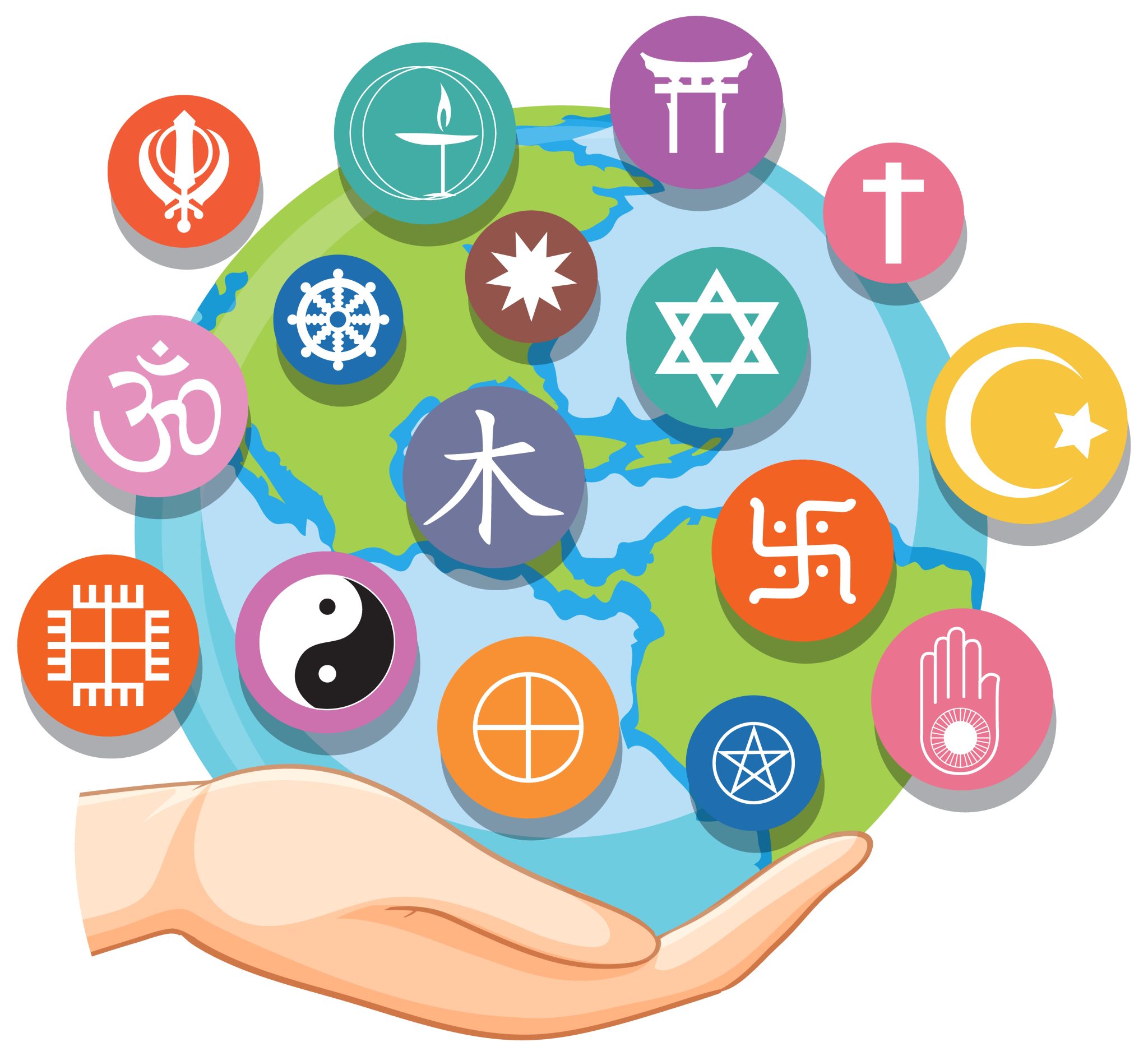
While there are around 10,000 distinct religions in the world, over three-quarters of the global population adheres to one of these four – Christianity (31%), Islam (24%), Hinduism (15%), and Buddhism (7%).
Demographics Of Christianity
Christianity, a faith that began nearly 2,000 years ago in the Middle East, is now followed by 2.4 billion people, and is the primary religion
practiced throughout the Americas, Europe, Oceania and sub-Saharan Africa. Half of Christians identify as Catholic, 37 percent Protestant, 12 percent Orthodox and 1 percent “Other”. The United States is home to the largest Christian population (11.3% of the world total), followed by Brazil (8%), and Mexico (5%).
Islam Demographics
Islam, founded in 622 CE, now has nearly 2 billion followers, the majority identifying in the two largest sects, Sunni and Shia. Muslims (followers of Islam) come from diverse ethnic backgrounds, speak hundreds of languages, and are the majority in
49 countries, covering the Middle East, Northern Africa, and parts of South Asia. The countries with the largest proportions of the world’s Muslim population are Indonesia (13.1%), India (11%), Pakistan (10.5%), and Bangladesh (8.4%). Karachi, Pakistan has the largest Muslim population of any city.
Hinduism Demographics
Hinduism is one of the oldest religions, beginning in Northern India around 2000 BCE. The overwhelming number of today’s 1.2 billion Hindus live in India and Nepal.
Buddhism Demographics
Buddhism, also with its roots in Ancient India, started in the 5th century CE. Countries with large Buddhist populations include Mongolia, Thailand, Myanmar, Laos, and Cambodia. About half of the world’s 500 million practicing Buddhists reside in China.
Religions with Smaller Followings
Another 7 percent of the global population identify with religions with much smaller followings. Judaism, though one of the three major Abrahamic religions (along with Christianity and Islam) is represented by just 0.2 percent of the global population (16 million), most of whom reside in Israel (7 million) and the U.S. (6 million). Had the Holocaust not wiped out over a third of world Jewry during World War II, it is likely the Jewish population would be
twice the size it is today.
An estimated 6 percent of the world’s population are
adherents of folk or traditional religions. These include African traditional religions, Chinese folk religions, Native American religions, and Australian aboriginal religions. Another 1 percent follow a variety of other faiths, including Baha’i, Taoism, Jainism, Shintoism, Sikhism, Tenrikyo, Zoroastrianism, Wicca, and many others.
The Non-Religious Population in the World
About 16 percent of people around the world have no religious affiliation. These “nones” include atheists, agnostics, and people who may believe in God or spiritual life but do not identify with any particular religion. The countries with the largest unaffiliated populations include China, Japan, and the United States. In the case of the United States,
those who reply “none” when asked about religion, have grown from 8 percent of the population in 2000 to 21 percent in 2022. In China and Japan, along with South Korea, North Korea, Czechia and Estonia, the majority of the populations have no religious affiliation.